

Conference marketing: a complete guide for academic events

Published on 25 Oct 2023 · Updated on 07 Jul 2026
Academic conferences are vital for knowledge dissemination, networking, and fostering collaboration among researchers. However, hosting a successful academic event requires more than just compelling content and knowledgeable keynote speakers. It requires effective marketing to ensure that your conference reaches the right audience and maximizes its impact.
This guide walks you through the essential steps of conference marketing: understanding your audience, defining your messaging, building your online presence, and promoting your event through social media, email, announcement sites and the press.
The way you promote your conference can be the difference between a successful, well-attended event and a conference filled with empty seats. Effective marketing is the key to attracting attendees, speakers, and sponsors, ultimately making your event a resounding success.
Manage submissions, peer-reviews, registrations and more.
1. Understanding your audience
Identify your target audience
The first step in conference marketing is to define your target audience. Understanding who your event is for will shape your marketing strategy.
Are you catering to researchers in a specific field, graduate students, or industry professionals?
Each group may require a different approach. If the event targets graduate students from a certain program (e.g. students enrolled in Biochemistry departments in a specific state or province), focus your promotion specifically on them to avoid attracting registrants from other programs or regions.
Audience segmentation: personas
Once you’ve identified your audience, consider segmenting it further with personas.
By creating detailed audience personas, you can tailor your marketing efforts to the specific needs and interests of different attendee groups. It’s a lot easier to know what to say when you know who you’re talking to.
To create audience personas for your academic event, you can conduct research and surveys among your target audience and last year’s event attendees to gather insights about their demographics, interests, and pain points.
Then, group this information into distinct personas, complete with names and detailed descriptions, highlighting their motivations, challenges, and goals related to attending academic conferences.
Here is an example of audience persona:
Doctoral Student Danielle:
- Background: Danielle is a doctoral student in biology, in her late twenties.
- Goals: She wants to present her research findings to gain feedback, network with potential collaborators, and improve her academic profile.
- Challenges: Limited budget, time constraints due to coursework, and the need for guidance in navigating academic conferences.
- Interests: Research publications, networking opportunities, and workshops to enhance her research skills.
So what would Danielle want from your event? What would peak her interest? What emails or social media posts would entice her to participate in your event?
These personas will serve as invaluable reference points to tailor your conference marketing strategies and content to resonate with specific audience segments.
This can also help you determine whether an in-person or virtual event would work better, which keynote speakers or topics should be included, and even the event date.
2. Setting clear goals
Specific and measurable goals
Setting clear and measurable marketing goals is paramount. Common conference marketing goals include;
- Increasing attendee registrations,
- Securing abstract submissions,
- Attracting sponsors.
Make sure your goals are specific, measurable, achievable, relevant, and time-bound (SMART). This will ensure that you can, and likely will attain your goals.
Here’s an example of a SMART goal for an academic event:
“Increase the number of registered attendees for the Annual International Psychology Conference from 300 to 500 within the next three months.”
Specific: Increase the number of registered attendees from 300 to 500.
Measurable: You can track and measure attendee registrations through your conference management platform.
Achievable: We will achieve this by implementing targeted marketing strategies, including email campaigns, social media promotion, and partnerships with academic institutions, to attract a broader audience.
Relevant: This goal aligns with our conference’s objective of promoting knowledge exchange and networking within the field of psychology.
Time-Bound: We aim to reach this goal within the next three months, leading up to the conference date on [specific date].
Ensure that your marketing goals align with the overarching objectives of the conference. Whether it’s disseminating research, fostering collaboration, or promoting a particular field, your marketing plan should support these objectives.
3. Defining your key messaging
Key messaging is the information you want to focus on when promoting your event. It’s important that every person on your organizing committee, especially those responsible for promoting the event, are aligned in terms of the key messaging.
Before any content is written or promotions are planned, work with the Marketing Chair on your organizing committee to determine the key message that your communications should convey. One of the primary responsibilities of the Marketing Chair is to create a marketing plan that will include every outreach and communication activity used to promote your event.
There are many conferences for people to choose from, so take the time to develop key messaging that sets your event apart from the rest. What’s interesting about your conference that makes it different from the other ones out there? Why should they choose your event? Once you can answer those questions, you have found your key messaging.
Maybe you want the main focus to be around ground-breaking new research that will be presented at the conference. If so, identify that as your key message and structure your communications around that information.
Assign promotion roles on your committee
Every member of your organizing committee has their own unique area of expertise. It’s likely that your Marketing Chair is the primary expert on all things related to public relations and social media, but you never know! Talk to your organizing committee and identify which members have specific skills or interest in promotions, and put those talents to work for the benefit of your event.
Once you’ve identified the experts, don’t be afraid to delegate tasks. Having one person in charge of social media and another in charge of public relations is a good way to divide responsibilities and ensure that every element of your communication strategy is being addressed and monitored. Encourage everyone involved in event promotion to provide the rest of the organizing committee with regular updates and metrics to assess the success of the strategy to date.
4. Crafting a compelling conference brand
A strong conference brand can make a significant difference in attracting conference attendees. Choose a unique conference name, design an eye-catching logo, and craft a memorable tagline to create a brand identity that resonates with your audience.
Maintain brand consistency across all marketing materials, including your website, social media profiles, and promotional materials. Consistency builds trust and recognition.
5. Building your online presence
The central hub: your conference website
Your conference website serves as the central hub for information, and it’s often the first place potential attendees and presenters will visit to learn more about the conference. Ensure it’s user-friendly, mobile-responsive, and contains all the essential details attendees need, from schedules to speaker bios and registration page.
Build a clear, well-designed website with a layout that’s easy to navigate on desktop and mobile, with an easy-to-find registration page and a clear list of the seminars, keynote speakers, and sponsors. The schedule should be clear, and registering for the event should be a breeze.
Make sure you design a complete event website so your attendees have all the information they need.
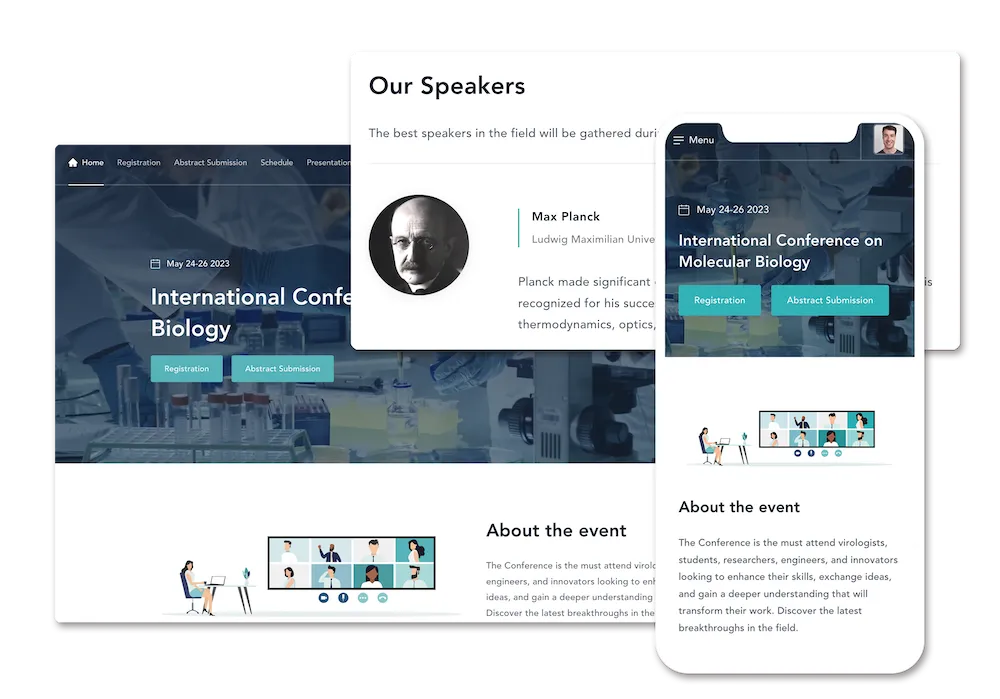
Fourwaves event website
You can use an all-in-one conference management system like Fourwaves to create your event website.
You can even try it for free.
Make your event findable on Google
Optimize your website based on search engine optimization (SEO) principles that make it easy to find in a Google search. In a nutshell, SEO means structuring your website to improve visibility when your target audience searches for things related to your event. By including the words and terms your potential presenters and attendees are searching online, your website will show up higher in their search results.
One way to optimize your website for search is to research the keywords that your target audience is using, and include content on your website that is focused on these keywords and terms. Create pages that could rank for searches your target audience might make, such as “Microbiology seminar in New York” or simply the name of your event.
For example, if your conference is about the impact of beef production on climate change, post blogs and white papers on your website that focus on agriculture, methane, greenhouse gas emissions, etc.
There are many tools out there that can help you research these keywords. A quick search for ‘free keyword research’ or ‘SEO tools’ will give you a lot to work with.
6. Social media strategies
Social media is a powerful promotional tool when used properly, but it’s important to think through your strategy before you get started.
1. Choose the right platforms:
Identify which social media platforms your target audience frequents the most. Common platforms for academic conferences include Twitter/X, LinkedIn, and Facebook. However, niche platforms or professional networks may also be relevant. For example, academics are often active on X and Bluesky, while research think-tanks may be more engaged on LinkedIn. Once you understand where your audience spends their time, focus your energy and resources on those platforms.
2. Create custom profiles:
Create social profiles specific to your event or organization. Find related organizations, researchers, and thought leaders, follow them and interact with their feeds. By liking and commenting on content from relevant organizations, you’ll become visible to their audience, which is likely your audience as well.
3. Develop a content strategy:
Plan a content calendar that gives you a monthly view of which content is being posted on which platform and when. Content should include announcements, speakers’ profiles, important dates, and engaging posts related to the conference theme or field. Find a tool that allows you to schedule posts in advance to save time and space your posts out appropriately.
4. Engage your audience:
Respond promptly to comments, questions, and messages on your social media posts. Engagement fosters a sense of community and encourages attendees to share their excitement. Use interactive content such as polls, quizzes, and live Q&A sessions.
5. Use hashtags:
Create a unique and memorable event hashtag (e.g., #PhysicsSymposium2026) and encourage attendees, speakers, and sponsors to use it in their posts. Regularly monitor the hashtag to track discussions and engage with users.
6. Share visual content:
Share visually appealing content, including images, infographics, and short videos, to grab attention and convey important information. Use graphics to announce speakers, highlight key sessions, and showcase venue details.
7. Consider paid advertising:
Consider running paid advertising campaigns on social media platforms and Google to reach a larger and more targeted audience. Use platform-specific targeting options to ensure your ads reach users who are likely to be interested in your event. You can segment per interests, job title, university, location, and more.
8. Think longer-term:
Set up discussion groups that allow conference attendees and presenters to discuss the content you are distributing before the event, and the information being presented at the event. This will also keep them engaged when the conference is over, making your job of promoting next year’s event much easier.
9. Monitor and analyze:
Regularly monitor the performance of your social media campaigns. Most platforms provide analytics tools to track engagement, reach, and other important metrics. Use these insights to refine your content strategy and make data-driven improvements.

Social media is a great way to connect with your potential conference participants.
7. Content marketing
Content marketing is a powerful tool for promoting academic conferences. One of the best ways to let others know about your event is to create interesting, engaging, shareable content that directs people to your website where they can learn more.
Your content marketing strategy can include a variety of different content formats, including:
- Long-form content like how-to guides and white papers
- Short-form content like blog posts, emails, and infographics
- Videos of venue tours or highlights of the city where the event will be hosted (assuming it’s in-person)
- Testimonial videos featuring people who have attended your events in the past discussing what they gained from the conference
- Videos that include your keynote speaker
- Highlight reels of notable moments in your keynote speaker’s career
Develop a content calendar and strategy, and distribute your content through your website, social media, email newsletters, and onsite.
8. Email marketing and outreach
Email marketing has one of the best returns on investment in digital marketing, and it remains one of the most effective ways to reach potential attendees, speakers, and sponsors.
Create a list of email addresses of people who registered for your event, have requested information about your event, people you’ve worked with in the past, potential sponsors, and other notable figures in your field. Depending on where you live, you may need consent to contact these people. Educate yourself on the laws regarding email communications where you live and follow those rules.
Even if your list is small at the beginning, it will grow. If your emails are interesting, engaging, and relevant to your field of study, your recipients will forward them to their friends and colleagues.
Plan to send regular communications to your email list. In these emails, include the content you’ve been building, updates on your event planning, networking opportunities, and important advancements in your field. Build and segment your list to ensure personalized outreach.
You could, for example, write templates for attendees, to guide them through the event from registration confirmation to updates about the event, and how to download the on-demand content after the conference. Another series of templates could be to reach out to potential sponsors or keynote speakers. It’s also very easy to craft emails for paper submitters, letting them know the status of their peer review.
Use an automated email platform that makes it easy to manage your lists, build professional-looking emails, and analyze their performance so you can constantly improve them.
9. Listing your event on conference announcement sites
For academics, one of the best places to find information about conferences is the conference announcement sites. Once you know the date, time, format, and location of your event and your website is launched, post it on these sites to let others know it’s happening. Some are paid and some are free, and some provide opportunities to boost your listing.
What are conference announcement sites?
Conference announcement sites are websites developed to alert the academic community about upcoming conferences. Organizers list events on these websites because they are a popular resource that researchers turn to when looking for opportunities to attend or present at academic conferences related to their work.
Many academics rely on these conferences as an important part of their career development. Most of the well-known announcement sites let academics register for notifications when a new event is posted that is relevant to their research. They are also a great resource for calls for papers or calls for abstracts.
There are two types of conference announcement sites: global announcement sites and industry-specific announcement sites.
Global announcement sites
Global conference announcement sites are directories of conferences taking place all across the world, covering a large variety of subject matters. Here are four of the best ones:
1. CFP List
CFP List is an international database of calls for papers across a wide array of disciplines. Its homepage has a handy map with pins marking the locations of upcoming academic conferences. It allows users to search for conferences by location or topic, and each conference write-up includes the event date, the abstract submission deadline, and the number of days left before abstracts must be submitted.
Conference Locate, or Clocate, is a multi-disciplinary, multi-national conference announcement site that lists events all over the world. It allows users to search events by name, keyword, location, organizer, or date, and offers a free monthly newsletter with conferences related to subscribers’ areas of interest. Event organizers can post to Clocate free of charge, with paid options for added visibility.
ourGlocal shares information about academic conferences and research meetings around the world, representing many disciplines. It allows users to filter events by year, topic, and country, and has an option to subscribe to their feed to receive notifications when a new event is listed.
This website acts as a directory for information about academic conferences taking place in countries around the world. It organizes conferences by field of study, and provides news, press releases and articles relevant to event organizers, presenters, and attendees. It’s free for conference organizers to list their event.
Industry-specific announcement sites
If your event is more niche or you want to announce it only to researchers in a specific field of study, industry-specific sites will be a better fit:
1. Science and technology: WikiCFP
WikiCFP lists conferences and calls for papers for science and technology researchers. It boasts over 100,000 calls for papers and is used by over 100,000 academics each month. It provides analytics to organizers, giving insight into the number of users that have viewed or followed an event posting, and organizers can promote their events free of charge.
2. Humanities and social sciences: H-Net
This site provides a wide range of information specifically targeting researchers studying the humanities and social sciences, including journal reviews, article discussions and job posts. The H-Announce section allows conference organizers to post their events, calls for papers, and calls for abstracts.
3. Economics and finance: INOMICS
If you’re organizing a conference related to economics and finance, INOMICS lists academic events for researchers in this discipline, plus resources like blogs, job postings, and scholarship opportunities.
4. Economics and finance: SSRN
The Financial Economics Network’s Professional Announcements is another great resource for researchers in finance and economics. Conference organizers can promote their events on this site, and researchers can sign up to receive notifications about calls for papers and academic events in their field.
5. Technology: All Tech Conferences
This site lists events related to technology, targeting researchers studying software development, IT infrastructure, telecom, gaming, data management, cybersecurity, and more. It is free to list events, with an option to boost your listing on the homepage.
Sites you should avoid
Unfortunately, with the increase in popularity of fake conferences, it’s important to carefully evaluate the announcement sites you’re planning to use. Just because an event is listed on a well-reviewed conference announcement site doesn’t mean that event is real.
Organizers of predatory conferences are often large, for-profit companies that organize dozens, even hundreds, of events targeting researchers across all disciplines. When choosing sites to announce your event, stick to announcement sites that list events attached to recognized, well-known academic organizations rather than private companies.
10. Sending a press release
Build a list of media and industry news outlets that your prospective audience subscribes to, write a press release about your event, and submit it to the organizational contact responsible for public outreach. You can also submit your press release through distribution services like Business Wire, Accesswire or Cision. These services have comprehensive, up-to-date lists of media contacts and will distribute the release on your behalf, but be prepared for a hefty price tag.
Try to avoid making the press release a basic announcement of your event. Your media contacts get multiple press releases each week, so find a hook that sets your event apart. For example, perhaps a recent study was released with an alarming statistic related to your conference theme. Use that as an introduction that highlights how your event applies to an important issue, then describe the ways the topic will be explored at your event.
Monitor the results of your press release. When it’s picked up by media outlets, promote their coverage on your website and social media. Sharing news about your event is great, but showcasing that objective, highly-regarded media outlets are sharing it is even better!
11. Working with influencers and partners
Influencer marketing extends to more industries than just fashion, food and fitness. Collaborate with thought leaders in your field who can help promote your event to a wider audience.
Ideally, the influencer you select would also be someone who is involved with, or speaking at, your event, such as one of your keynote speakers. Having a keynote speaker as your promotions influencer is beneficial for all involved: more people attending the event means more people exposed to their work.
If you don’t have a keynote speaker or wish to consider alternative voices, identify the most influential figures in your particular field and reach out to them to build a partnership that helps promote your event. Be prepared that they might ask for a financial incentive, so it’s a good idea to have a budget in mind.
You can also work with your sponsors and partners: their sponsorship deals can include event marketing on their social media pages and email marketing to their own audience.
12. Engaging speakers and sponsors
Attracting high-profile speakers
High-profile speakers can draw in attendees. Reach out to respected figures or industry leaders in your field and highlight the value of speaking at your event.
The sponsorship advantage
Sponsorships provide crucial financial support and enhance the conference’s prestige. Approach potential sponsors with compelling sponsorship packages.
There are multiple tips to craft a great sponsorship plan for your conference, make sure to take advantage.
13. Tracking and measuring success
Identify key performance indicators (KPIs) to track your marketing efforts. Common KPIs include website traffic, email open rates, registration numbers, and social media engagement.
Use analytics tools to monitor your marketing performance. Gain insights from data to adapt and improve your strategies.
14. Budgeting and resource allocation
Plan your marketing budget carefully, allocating resources for various marketing channels. Be mindful of cost-effective strategies and ROI.
You can use a conference budget template to help you stay on track.
Strategically allocate your resources to maximize return on investment. Consider cost-effective digital marketing techniques and explore partnerships.
Conclusion
Effective conference marketing is a complex but rewarding endeavor. By understanding your audience, setting clear goals, defining your key messaging, building your online presence, and promoting your event through social media, email, announcement sites, the press and partners, you can increase the visibility and success of your academic event.
Keep tracking your progress, adapt your strategies as needed, and remember that marketing is an ongoing process that requires dedication and creativity.
Good luck, and may your event be a resounding success!
Fourwaves