

How the Microscopical Society of Canada runs its academic conference with Fourwaves
Published on 04 Jun 2026
Organizing a national scientific meeting means juggling the website, abstracts, peer review, registration, payments, communications, and a yearly handoff between organizing teams. Since 2019, Fourwaves has brought all of that together in one place for the Microscopical Society of Canada.
Academic society meeting with scientific talks, student training, and social events
Scientific society
Simplify conference planning, centralize abstract submissions and peer review, streamline registration and communications, and align the annual meeting from one organizing committee to the next.
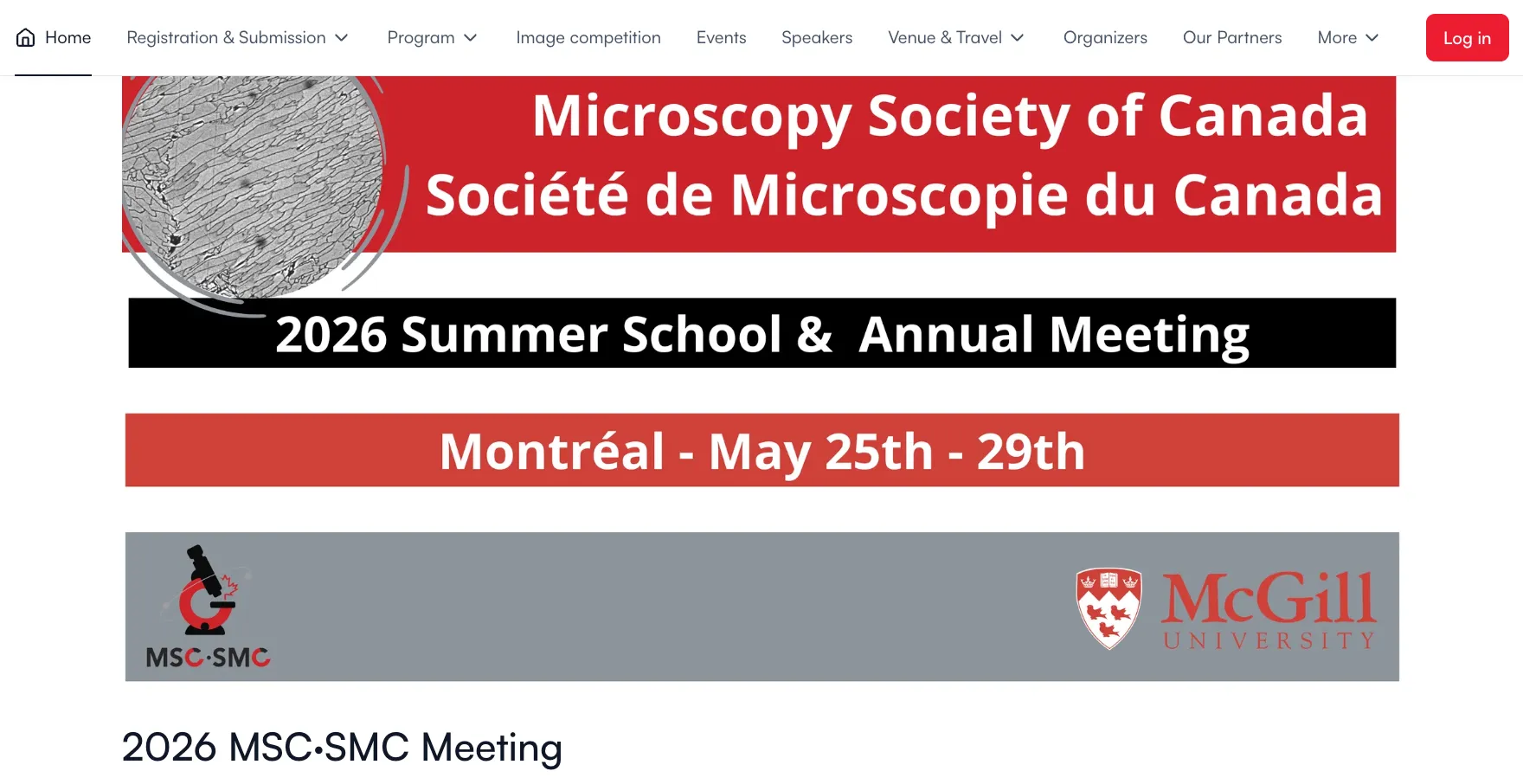
The Microscopical Society of Canada runs its annual meeting (website, abstracts, peer review, registration, and payments) on Fourwaves.
About the Microscopical Society of Canada annual meeting
Every year, the Microscopical Society of Canada brings together people from across the country who work with microscopy in one form or another. Some are students just getting started. Others are post-docs, researchers, principal investigators, lab teams, or industry partners. What they have in common is a shared interest in microscopy and a reason to come together to exchange ideas, showcase work, and connect with others in the field.
The annual meeting usually spans three to five days and includes scientific talks, abstract presentations, student training opportunities, and social events. Depending on the year, it draws between 100 and 250 attendees and somewhere between 70 and 150 abstract submissions. The 2026 edition, the society’s 52nd annual meeting, takes place May 25 to 29, 2026, at McGill University in Montreal, and is preceded by a hands-on Microscopy Summer School.
Mouhanad Babi, Secretary of the society, member of the organizing committee, and the Facility Manager at the Centre for Advanced Light Microscopy (CALM), supports website updates, communications, advertising, and advisory work. He is one of the people helping make sure the event comes together.
The challenge: managing abstract submissions, peer review, and registration
From the outside, an academic meeting can look fairly straightforward. People register, submit abstracts, show up, and present. Behind the scenes, it is another story.
There are deadlines to respect, reviewers to coordinate, sponsors to inform, websites to update, messages to send, payments to track, and dozens of small details that have to line up at the right time. When everything is spread across different tools, things can get complicated.
Mouhanad was not yet involved with the event before MSC adopted Fourwaves, so he cannot speak directly to the earlier setup. But he suspects, like many organizers would, that relying on separate tools likely created the usual problems: disconnected information, more manual coordination, and more room for confusion.
The real challenge is keeping submissions, reviews, registration, and communications from turning into separate workflows.

Facility Manager, Centre for Advanced Light Microscopy (CALM), McMaster University
This kind of fragmentation can slow down event planning workflows and make continuity harder, too. When organizing committees change from year to year, scattered event planning systems can turn even basic handoffs into a chore, with the risk of losing organizational memory.
Fourwaves: centralized event planning for scientific societies
MSC started using Fourwaves in 2019. At the time, the platform stood out as a strong option for virtual and hybrid event setup, especially during the COVID period. But what kept it useful went well beyond that period.
For the conference organizing team, one of the biggest advantages has been how easy it is to get an event up and running. Instead of rebuilding everything from scratch, event planners can use previous editions as a starting point and quickly create a polished event website with the key information prospective attendees and sponsors need.
In addition, event site creation, registration, abstract submission, peer review, payments, and communications all live in the same platform. That means less juggling, less duplication, and far fewer opportunities for something to fall through the cracks.
How Fourwaves simplifies peer reviews and abstracts
For MSC, peer review is one of the most important parts of the event workflow. Abstracts need to be reviewed fairly, consistently, and in a way that reflects the priorities of the organizing and scientific committees.
That is where Fourwaves has been very useful.
MSC uses the platform’s peer-review module to assign abstracts to reviewers and to orchestrate evaluations in a more structured way. The committee can build a review form that includes rankings, comments, and clear accept-or-reject options, all in one place. The rubric can also be adjusted from year to year depending on the needs of the event.
This flexibility helps to standardize the review process without making it rigid. Reviewers have a clearer framework to work within, and organizers save time overseeing the whole event planning process.
We can tailor the evaluation process each year without having to rebuild it from scratch.
Facility Manager, Centre for Advanced Light Microscopy (CALM), McMaster University
Academic conference continuity from one year to the next
One of the most useful things Mouhanad highlighted was not just the day-to-day convenience of Fourwaves, but what it does for long-term continuity.
Academic societies often rely on committees that evolve over time. Roles shift. Responsibilities move around. New people step in. When event history is buried across old inboxes, shared drives, and half-forgotten systems, every new committee ends up wasting unnecessary time.
With Fourwaves, current and previous events stay accessible in one place. For Mouhanad, that is a real operational advantage. He sees firsthand how instrumental the software is to keep things moving when submissions, registrations, payments, communications, and event history are all connected.
“There is less time spent retracing steps and more time spent moving the event forward.”
How Fourwaves improves the organizer and attendee experience
Attendees do not usually send glowing emails about registration forms or abstract portals. They tend to notice those event planning tools only when something goes wrong.
That is why Mouhanad sees the lack of criticism as a positive sign. MSC has received little to no complaints about the submission or registration process, which he considers a major win. Over the years, he has also heard appreciation for the platform from multiple organizing committees.
“In a crowded event landscape, attendee experience plays a big role in whether people return year after year.”
Why MSC continues to use Fourwaves year after year
The Microscopical Society of Canada has continued to use Fourwaves since 2019 for a few simple reasons: it is easy to use, it builds on previous events, it continues to improve, and the customer service is strong.
Mouhanad would absolutely recommend Fourwaves to other academic societies and conference organizers, especially for larger events where the administrative burden can get heavy fast.
Re-examining the event technology stack can open the door to better workflows, better continuity, and a better experience for everyone involved.
Facility Manager, Centre for Advanced Light Microscopy (CALM), McMaster University
Book a 15 minute call and we'll show you how Fourwaves can help.