
Best Oxford Abstracts alternatives for academic conferences: 6 tools compared (2026)

As of November 2026, the best Oxford Abstracts alternative for academic conferences is Fourwaves, for four reasons. It offers the same level of features for abstract submissions and peer review. It sits at a similar price point: Oxford Abstracts charges $890 to $3,450 per event, and Fourwaves $999 or $2,599 per year for unlimited events, which suits a conference that comes back every year. Its interface is intuitive enough for a small team to set up a call alone. And every Fourwaves plan, the free one included, comes with a native conference app, along with the event website, registration and the program builder. Oxford Abstracts has no native app and keeps its program builder for its conference packages, from $2,290.
Ex Ordo is the other specialist for academic conferences, and it suits organizers who prefer a vendor that sets up the call for them. EasyChair and ConfTool suit program committees that mainly review abstracts and papers in depth, and Cadmium and Whova are broader event management platforms with an abstract module.
I’m the founder of Fourwaves, so read this comparison knowing where I stand. Every price and feature of another tool was checked on that tool’s own website in November 2026 unless I say otherwise, and one section says when Oxford Abstracts remains the better choice. Looking beyond these six? My best abstract management software comparison covers 13 tools, and the Fourwaves abstract management software page shows the product itself.
What is Oxford Abstracts?
Oxford Abstracts is abstract management software for academic conferences, made by a UK company. It collects abstract submissions and runs peer review and decisions. Delegate registration is available on every package, and its conference packages add a program builder and tools for a virtual conference, such as live video links and a poster gallery. Oxford Abstracts is sold per event, from a free Basic package to $3,450, and reports more than 1,000 events a year in over 100 countries (oxfordabstracts.com, November 2026).
Why organizers look for an Oxford Abstracts alternative
Oxford Abstracts is a UK company that has built abstract management software for academic and scientific conferences for more than twenty years, and its abstract management system is solid on submission and review. Conference organizers who look for an Oxford Abstracts alternative usually give one of five reasons. The prices below come from the Oxford Abstracts pricing page, checked in November 2026.
- Every event is billed again. Oxford Abstracts sells one-off packages per event: $890 for Abstract Management, $2,290 for Standard Conference and $3,450 for Professional Conference (USD). A society with an annual meeting, or a department that runs several research days, buys a package for each one.
- Several modules are add-ons. The symposium module and multi-stage submissions cost $850 each per event, and certificates cost $150 below the Professional package.
- The event website expires. The website builder costs $200 for twelve months of access. After that the site stops being public unless you pay for an extension.
- There is no native app. Attendees open a mobile web version in their browser. Oxford Abstracts argues on its blog that a conference does not need an app.
- Access to past event data is guaranteed for one year. Every package lists event data access for one year after the event, and the pricing page adds that data is deleted seven years after the event in practice.
When Oxford Abstracts is still the right choice
Oxford Abstracts is still the right choice for a call for abstracts built around symposia. Its symposium add-on collects a panel, workshop or roundtable together with the abstracts inside it. Fourwaves has no module for this yet, although conferences do run a call for sessions on it: ArcticNet collects session proposals first, then the abstracts for the accepted sessions (customer story). Oxford Abstracts is also a good option if you have several submission stages, with its multi-stage add-on.
Oxford Abstracts also has finer rules for assigning reviewers. From its $890 package, automatic assignment can match reviewers to submissions by category and exclude reviewers who share an email domain with the authors. Fourwaves never gives reviewers their own or co-authored submissions and lets them declare any other conflict, but it has no rule by email domain, and matching by track comes with tracks management.
Oxford Abstracts also suits a committee that runs one call a year and needs nothing but abstract collection and review. The Abstract Management package covers that for $890 per event. Its free Basic package accepts unlimited submissions, with a submission form capped at nine questions and no automatic reviewer assignment.
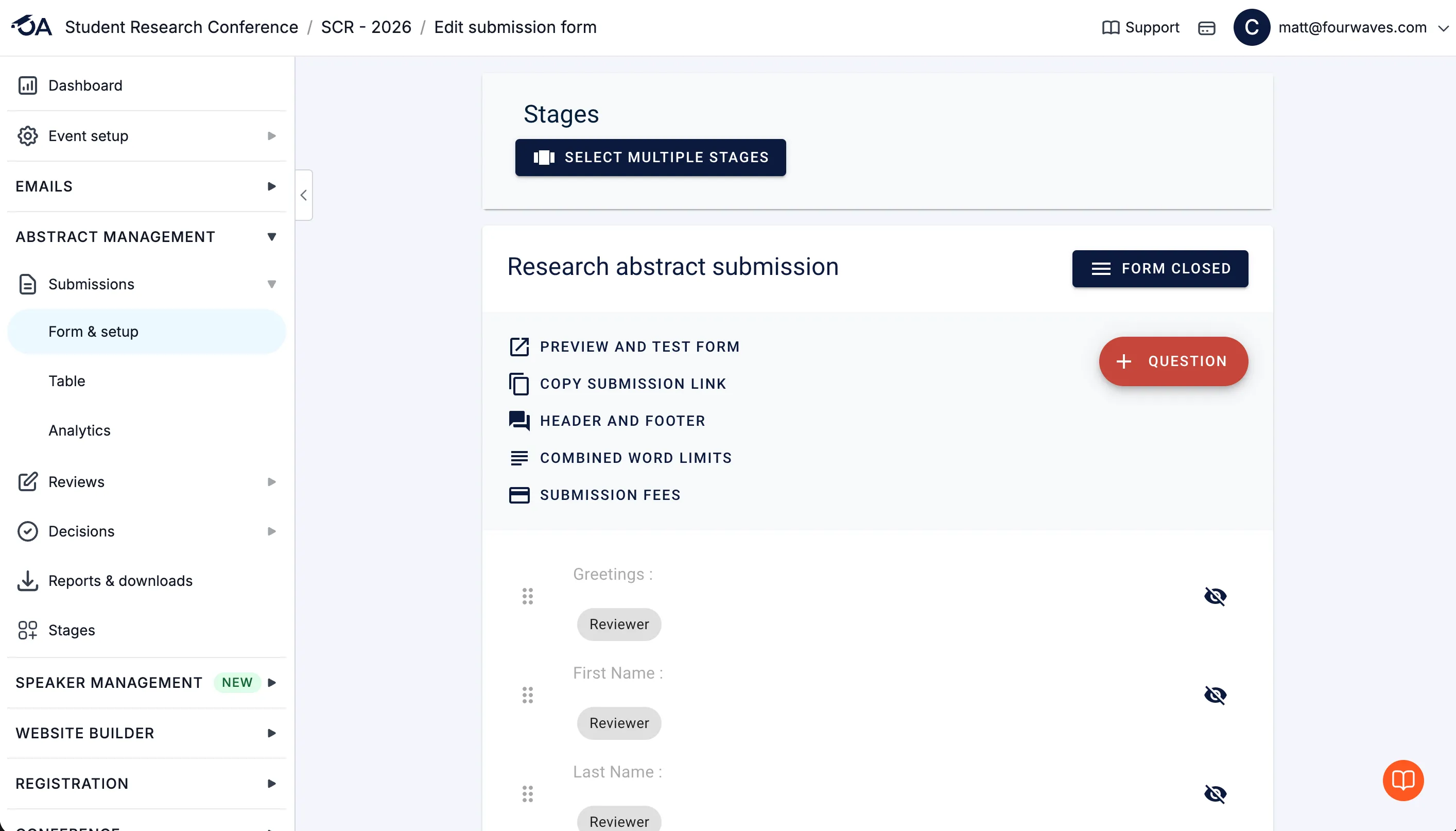
The Oxford Abstracts form builder, captured in my own Oxford Abstracts account
What to look for in an Oxford Abstracts alternative
Six questions separate the Oxford Abstracts alternatives from one another, beyond their lists of features. Conference organizers should decide which ones matter before they compare other tools.
- How do you pay? Per event, per submission or per year, and which modules cost extra.
- How much of the event does the tool cover? Submission and review only, or the event website, registration, program building and the app as well, for in-person, hybrid and virtual events.
- How deep is the review? Blind review, the way you assign reviewers, conflicts of interest and committee roles.
- Do you collect session proposals or a second stage? A dedicated module, or separate submissions and files that accepted authors add later.
- Is there a native app? Included, sold as an add-on, or a mobile web page.
- What happens after the event? How long the website, the program and your data stay available.
Peer review related features are worth testing in every tool, because reviewers are the part you control least. In Fourwaves data on academic conferences, 1 reviewer in 7 completes none of the reviews they are assigned, and 41% of calls with peer review hide authors from reviewers for a double-blind review (abstract and peer review statistics, November 2026). Check how each alternative assigns reviewers to submissions to avoid conflicts, reminds late reviewers and runs a blind review.
How we evaluated these Oxford Abstracts alternatives
The six Oxford Abstracts alternatives on this page were compared in November 2026 on pricing model, how much of the event each tool covers, review depth, session proposals and second stages, the native app and what happens after the event. Tools built for academic conferences come first, then the association and event platforms that also collect abstracts.
- Used hands-on: Fourwaves, Oxford Abstracts, EasyChair, ConfTool and Whova in my own accounts, and Ex Ordo through its demo environment. The screenshots of those tools come from these sessions.
- Assessed from public sources: Cadmium, from its website, its documentation and reviews. Its screenshot comes from its support documentation.
- Prices and features: read on each vendor’s own website, dated next to each price.
- Disclosure: Fourwaves publishes this page and I founded it, so it is listed first. Every other entry names the conference it suits best.
Oxford Abstracts alternatives at a glance
Of the seven tools in the Oxford Abstracts comparison table, three publish their prices (Oxford Abstracts, Fourwaves and EasyChair), four have a free option (the same three and ConfTool) and one includes a free native app on every plan (Fourwaves).
| Tool | Free option | Website and program building | Native app | Pricing model |
| Oxford Abstracts | Free Basic package, unlimited submissions, nine form questions | Program building in the conference packages, website as an add-on | No, mobile web | Published, per event: $890 to $3,450 plus add-ons |
| Fourwaves | Free plan, 50 submissions a year | Both on every plan | Yes, free on every plan | Published, per year for unlimited events: $999 and $2,599, Pro on quote |
| Ex Ordo | None listed | Programme builder, no event website described | Add-on powered by Guidebook | Quote per event |
| EasyChair | Free licence, up to 20 submissions | Program and conference pages on paid licences, no website builder | None listed | Published, per submission from $3.70 |
| ConfTool | Free Standard licence, self-hosted, up to 150 participants | Program on Pro, no event website | No, third-party apps on Pro | Quote (Pro) |
| Cadmium | None | Both, in the Eventscribe suite | Yes, sold in the suite | Quote |
| Whova | None | Agenda and event webpages | Yes, its core product | Quote |
The 6 best Oxford Abstracts alternatives
The six best Oxford Abstracts alternatives are Fourwaves, Ex Ordo, EasyChair, ConfTool, Cadmium and Whova. Fourwaves, the one I build, comes first, then the tools made for academic conferences, then the other platforms with an abstract module.
Fourwaves: best for the same features at a similar price, with a free conference app
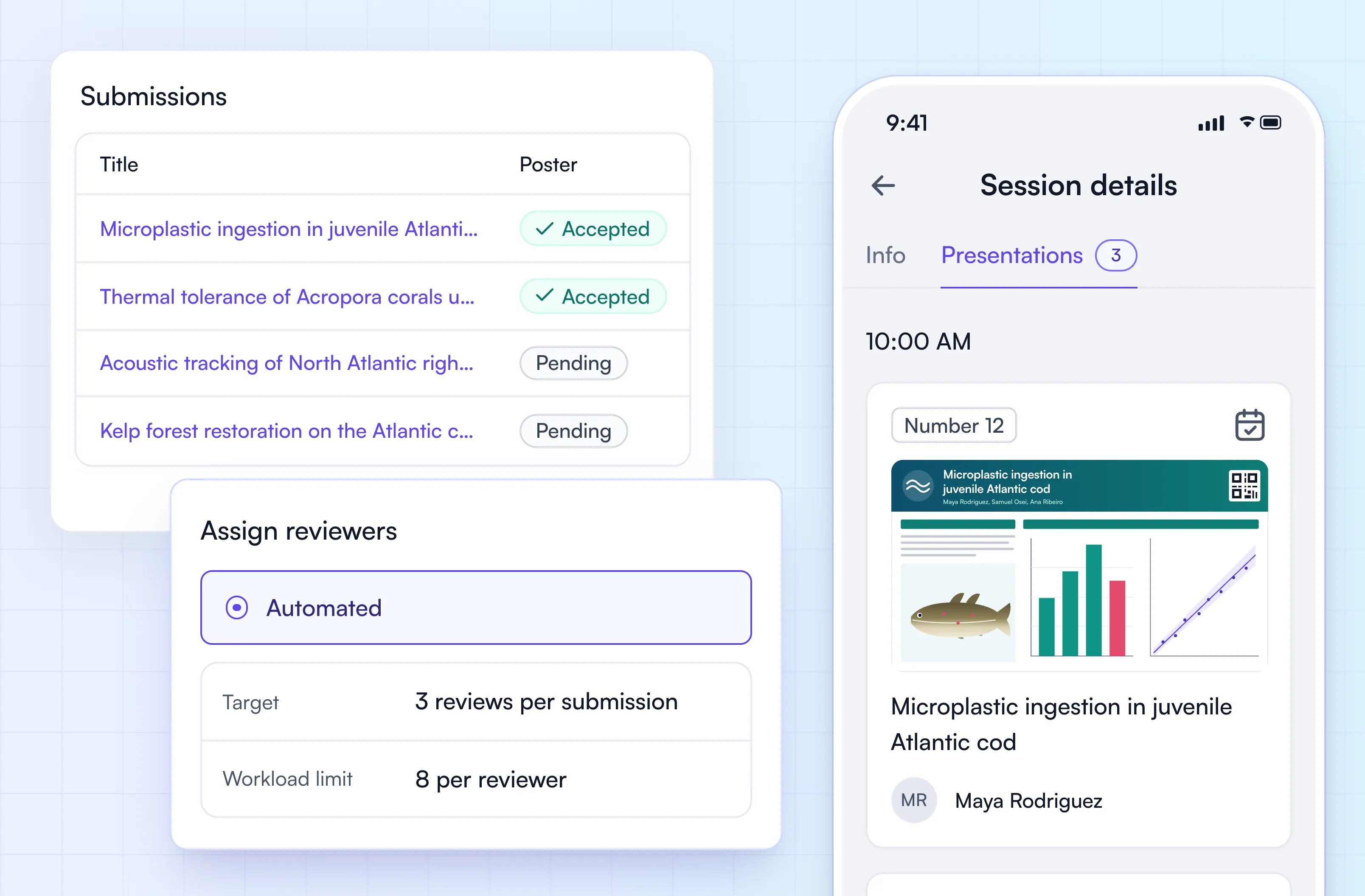
Submissions, reviewer assignment and the conference app in Fourwaves: an accepted abstract goes from the submissions table to the program in the app
Verdict: submission and review features comparable to Oxford Abstracts at a similar price, in an intuitive interface, with the website, registration, program builder and conference app included in every plan.
Fourwaves is conference management software for academic conferences: abstract submissions, peer review, registration, event website, program and conference app in one platform, built for researchers at universities, scientific societies and research networks. Fourwaves runs academic conferences of any size, from international society meetings to departmental research days. I build it, so weigh this entry with that in mind. PhD students who organized scientific conferences started it, and it still serves the academic community first. Organizers create their event, publish their call for abstracts and manage submissions themselves, without a sales call, for events held in person, hybrid or as a virtual conference. The Geological Association of Canada has run its national conference on Fourwaves since 2022, with about 800 participants and 500 abstracts a year (customer story).
Strengths:
- Peer review at the level of Oxford Abstracts: the peer review software uses a review form you build, hides author names from reviewers for a blind review, assigns reviewers automatically with a cap on each reviewer’s workload and never to their own or co-authored submissions, and lets you share review results with authors.
- An interface organizers pick up quickly: at ArcticNet, the organizer who took over the meeting values most how intuitive Fourwaves is, and nobody on the team needs to code (customer story).
- One yearly plan instead of a package per event: every plan covers unlimited events with no add-ons, and the only usage limit is the number of abstract submissions per year across your events.
- The whole conference on one account: the event website, registration and payments, the conference program builder, a virtual platform with live chat and live stream links, and a free iOS and Android conference app are on every plan, the free one included.
- Self-serve from the first form to the payment: you create the event, build your forms and buy a plan online without a sales call, with chat and email support on every plan.
- Abstracts that flow into the program: the abstract management software sends accepted abstracts to the program, the website, the abstract booklet and the app without copy and paste.
- Past editions stay online: the website, program and abstracts of earlier editions remain available at no cost, and the next edition starts from a clone.
Limitations:
- No dedicated symposium module yet: a session proposal and its abstracts are collected as separate submissions.
- Peer review with scoring starts on the Advanced plan, and the free and Essential plans collect submissions and record accept or reject decisions per presentation type you create, without it.
Pricing: free up to 50 submissions a year. Paid plans are Essential at $999 USD a year for 100 submissions and Advanced at $2,599 USD a year for 300 submissions with peer review, and Pro is quoted on your volume. A 2 or 3 year term takes 10% off. A 3% service fee applies to card payments, on top of the fees of your own payment gateway. The pricing page lists what each plan includes.
Fourwaves vs Oxford Abstracts
Fourwaves and Oxford Abstracts are close on submission and review features and on price. They differ in how you pay and in what a plan includes. The table compares the two on ten points, with Oxford Abstracts facts taken from its website in November 2026.
| Criterion | Fourwaves | Oxford Abstracts |
| Pricing model | Yearly plan, unlimited events, no add-ons | One-off package per event, plus add-ons |
| Published prices (USD) | Free, $999 and $2,599 a year, Pro on quote, 10% off on a 2 or 3 year term | Free, $890, $2,290 and $3,450 per event |
| Free option | 50 submissions a year, no limit on form questions, no review scoring | Unlimited submissions, nine form questions, no automatic reviewer assignment |
| Peer review | Custom review form, author names hidden for blind review, automatic assignment with a workload cap, authors never assigned their own submission and results can be shared with authors | Submitter details hidden from reviewers by default, automatic assignment with matching by category, option to exclude the same email domain |
| Session proposals | Collected as separate submissions | Symposium add-on, $850 per event |
| Second submission stage | Accepted authors edit their submission and add files | Multi-stage add-on, $850 per event, with a review per stage |
| Event website | Included on every plan | Website builder included in Professional, otherwise a $200 add-on for twelve months, then paid extensions |
| Registration and payments | Included, 3% service fee on card payments, negotiable based on volume, plus your own gateway’s fees | Included, 2.5% on revenue capped at $5,000 per event, plus processor fees |
| Conference app | Free native iOS and Android app on every plan | No native app, mobile web |
| Past events | Website, program and abstracts stay online at no cost | Event data access listed for one year after the event |
Book a demo and we'll walk through your current call for abstracts and how it would run in Fourwaves.
Ex Ordo: best for organizers who want the vendor to set up the call
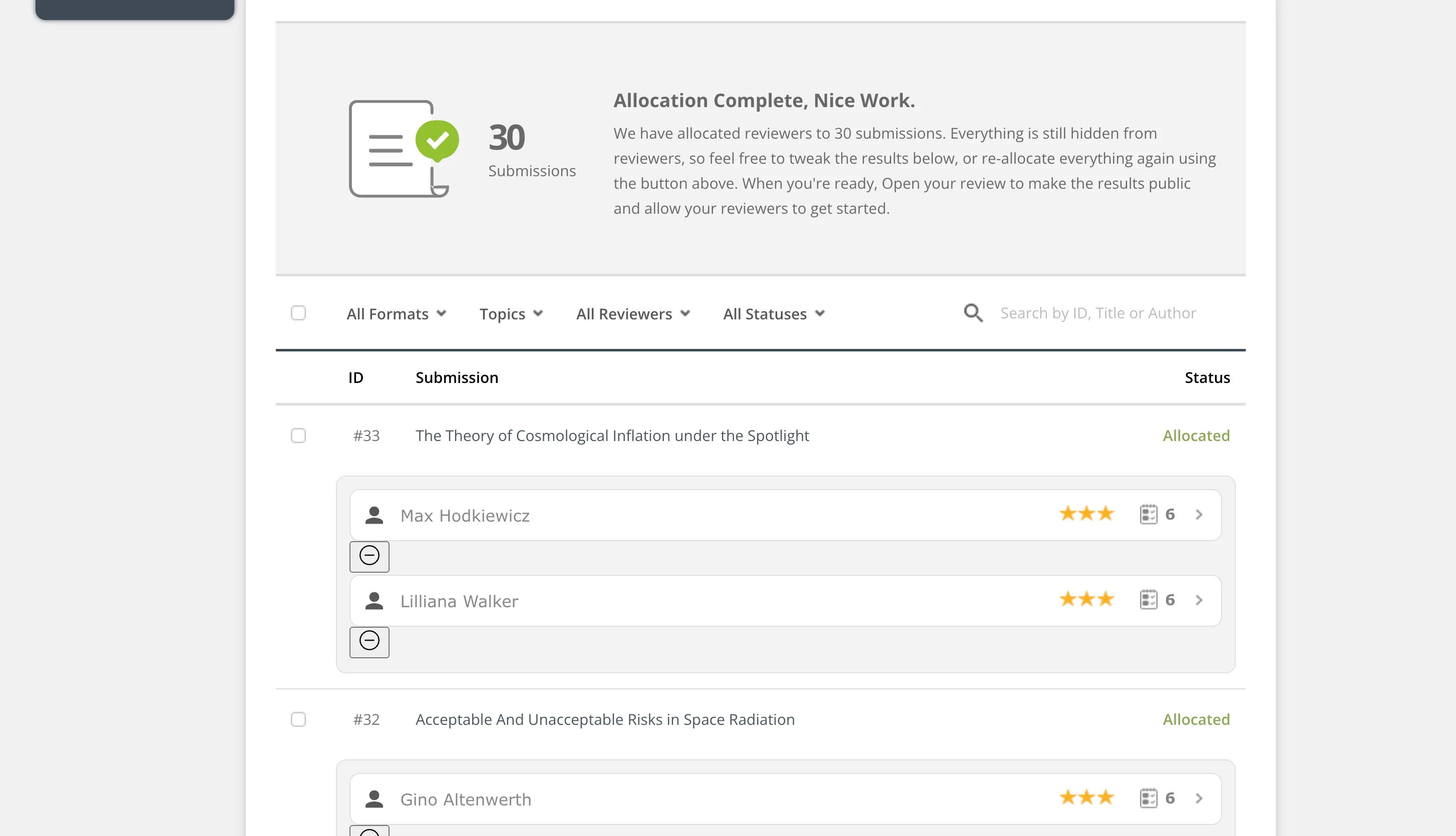
Reviewer allocation in Ex Ordo, seen through its demo environment
Verdict: review management on a par with Oxford Abstracts, configured by Ex Ordo’s team and priced by quote.
Ex Ordo is based in Galway, Ireland, and serves scholarly societies. Its allocation engine matches reviewers to submissions by topic with a workload cap and, by default, excludes reviewers from the authors’ email domain or organization. Panels and symposia have been available since April 2024, which covers the need Oxford Abstracts meets with its symposium add-on. It sells registration and a programme builder, the mobile app is an add-on powered by Guidebook, and its site describes no tool to build the event website.
Pricing: by quote per event, with no free plan or sign-up on its website (exordo.com, November 2026).
Best for: organizers who prefer that the vendor configures the workflow for them.
Less ideal if: you want published prices or to set up the platform yourself. My Ex Ordo alternatives guide covers that switch.
EasyChair: best for technical program committees that want bidding
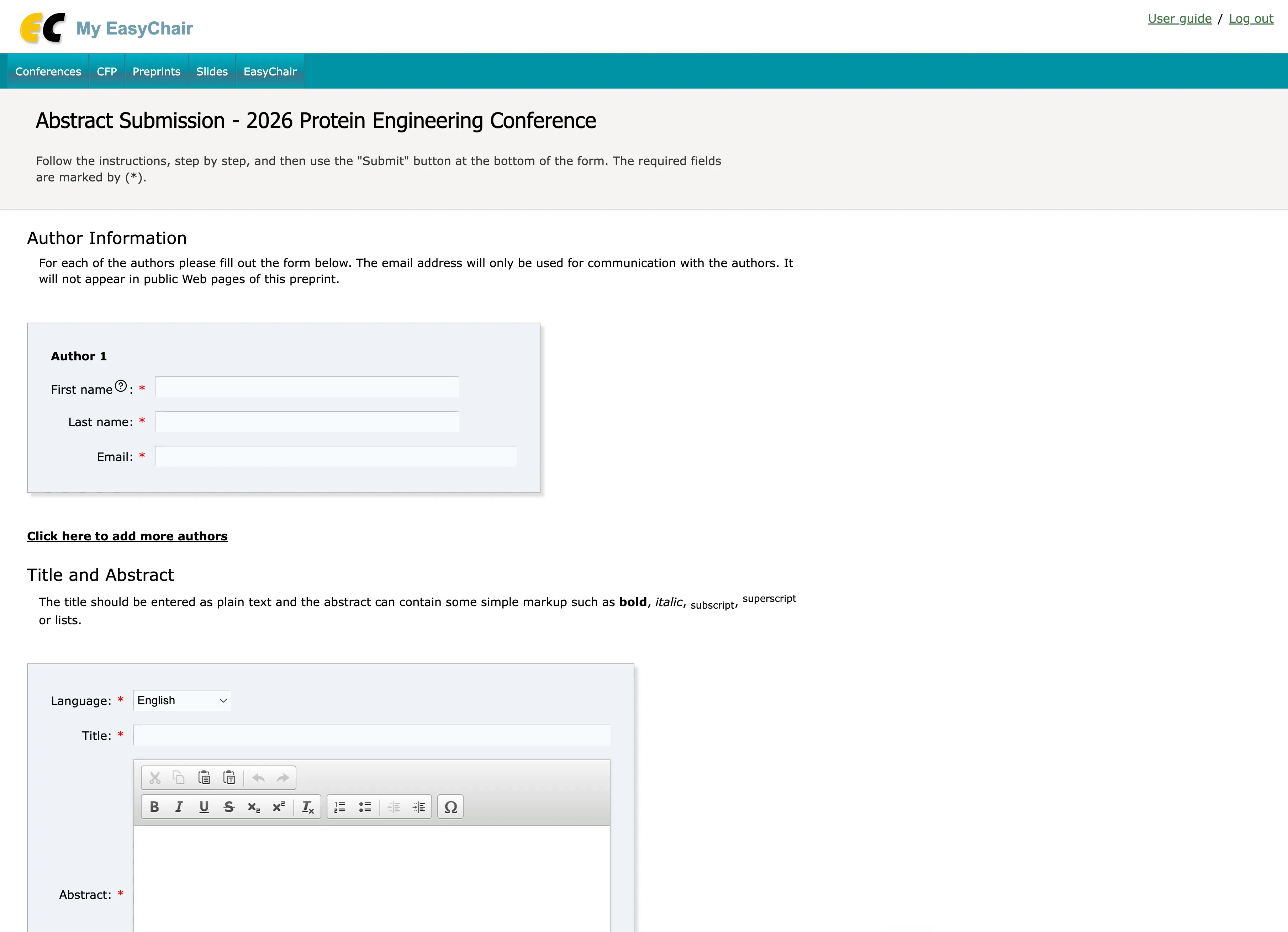
The EasyChair submission form as authors see it in 2026
Verdict: deeper committee review than Oxford Abstracts, priced per submission, in a dated interface.
EasyChair, based in Manchester, UK, reports more than 125,000 conferences run on its platform (easychair.org, November 2026). Its peer review workflows include reviewer bidding, assignment with constraints and online discussion between committee members on every licence, which goes further than the matching by category in Oxford Abstracts. EasyChair has no website builder, though its Smart Program generates the program and conference pages on paid licences, and it lists no mobile app.
Pricing: published per submission. The Professional licence costs $3.90 per submission up to 60 submissions, and Executive runs from $6.10 down to $3.70 per submission by volume on the fixed-price plan. A free licence for up to 20 submissions is listed, and organizers tell us it is hard to obtain in practice (easychair.org, November 2026).
Best for: technical program committees that want bidding and already know EasyChair.
Less ideal if: you want a modern experience for authors and reviewers, or the website, registration and app in the same tool. My EasyChair alternatives guide covers that switch.
ConfTool: best for multilingual conferences that want deep committee review
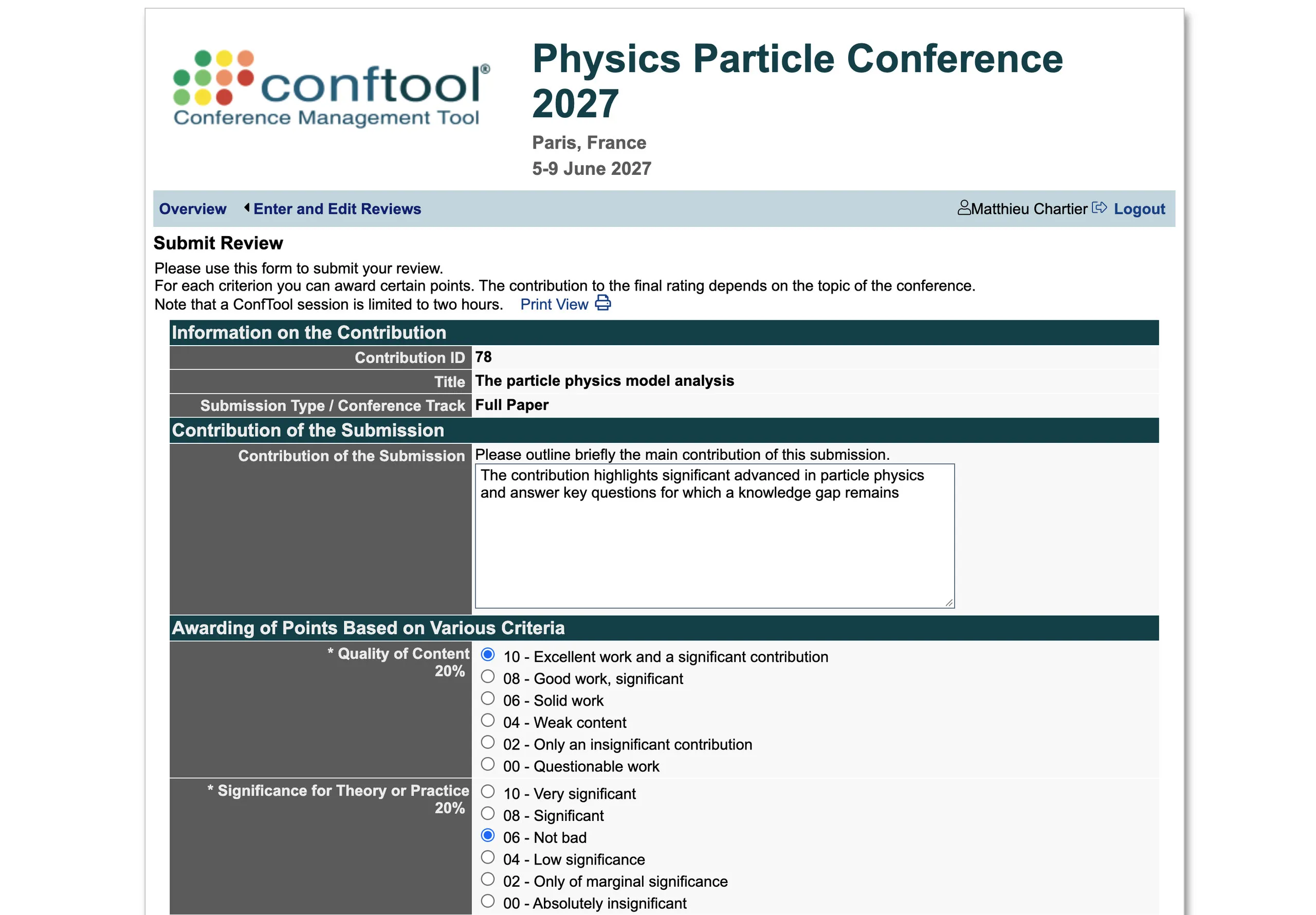
The reviewer view in my ConfTool account, with a score to give on each weighted criterion
Verdict: reviewer bidding and broader conflict detection than Oxford Abstracts, in a dated interface and without self-serve access.
ConfTool is made in Hamburg, Germany. Its Pro edition offers reviewer bidding, rebuttals, weighted review criteria and conflict detection by email, domain and organization, with registration and invoicing through your own payment gateways. A free Standard licence covers non-commercial academic events of up to 150 participants, installed on your own server and without support. ConfTool does not build the event website and relies on third-party apps for mobile.
Pricing: the Standard licence is free on request, and ConfTool Pro is priced by written offer (conftool.net, November 2026).
Best for: conferences that need forms and emails in several languages, up to four per installation on Pro.
Less ideal if: you want to start today without requesting a licence or an offer.
Cadmium: best for association meetings with continuing education
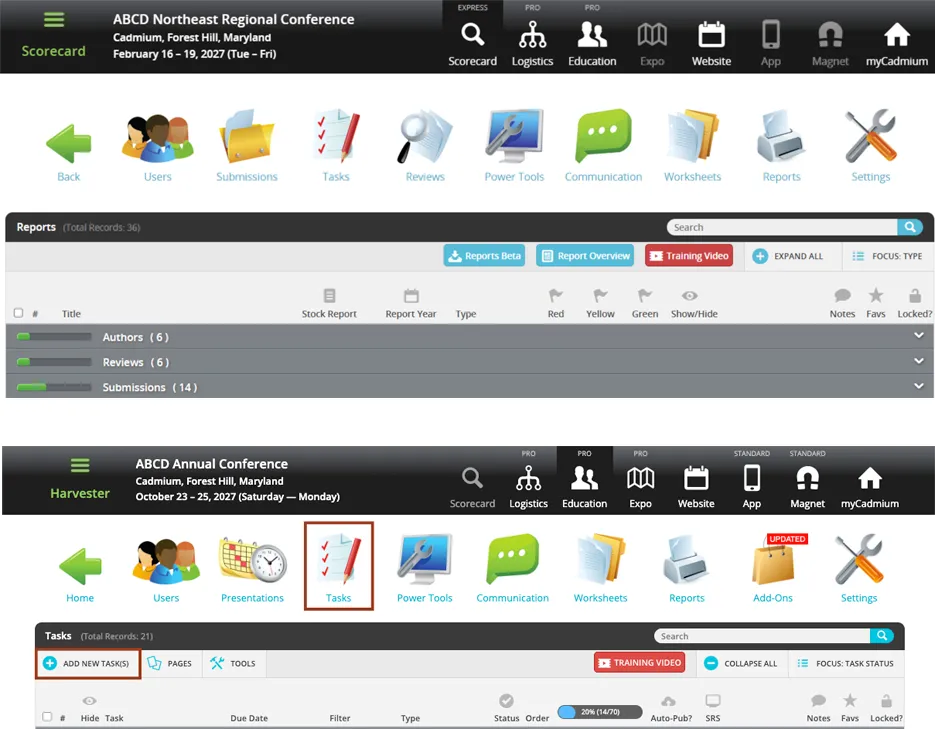
Cadmium’s submission and task screens, as shown in its public support documentation
Verdict: a full association event suite, far broader and heavier than Oxford Abstracts.
Cadmium, an event technology company with offices in Forest Hill, Maryland, and Philadelphia, sells abstract management as the Submissions and Reviews module of its Eventscribe suite. Submissions are broken into tasks such as the abstract, the authors, the disclosure and the upload, and the suite adds a speaker portal, the event website, an app and integrations with association management systems. Cadmium’s team does the initial configuration, and changes such as new submission types go through a Cadmium project manager.
Pricing: by quote only (gocadmium.com, November 2026).
Best for: associations and medical societies that tie abstracts to speakers, disclosures and continuing education.
Less ideal if: you run a standalone academic conference and want to set it up yourself.
Whova: best for events built around the attendee app
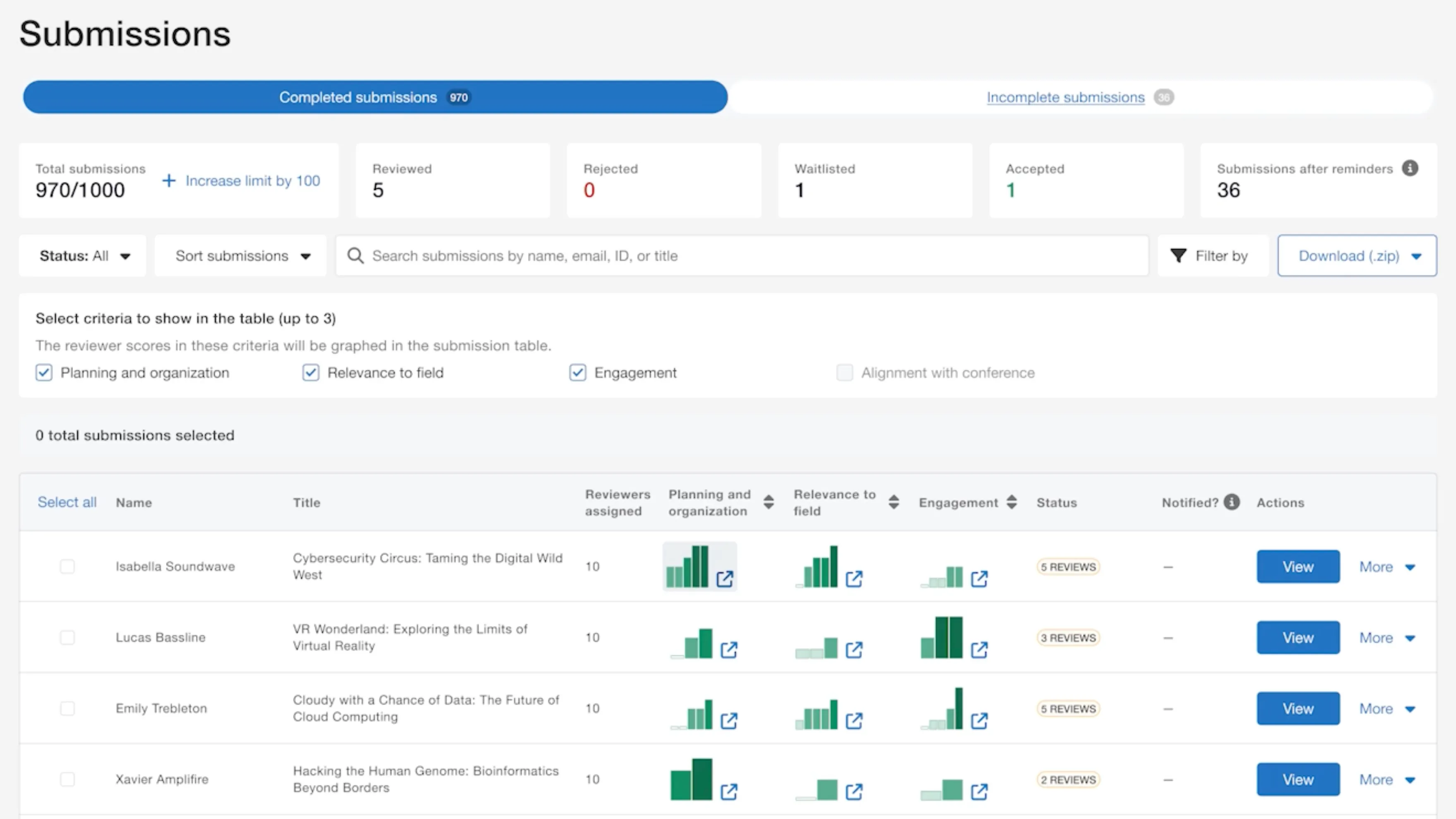
A test event in my Whova account, open on the submission dashboard
Verdict: an attendee app with leaderboards, contests and matchmaking, and an abstract module that is newer and shallower than Oxford Abstracts.
Whova started as an event app in San Diego and announced its call for speakers and abstracts module in March 2024. Reviewers are assigned by topic, at random or by hand, and accepted submissions appear in the app as sessions. Blind review is not on the entry tier, and Whova produces no book of abstracts.
Pricing: by quote, with the call for speakers module sold in tiers (whova.com, November 2026).
Best for: events where networking and the app matter more than review depth.
Less ideal if: peer review is the heart of your conference. My Whova alternatives guide goes deeper.
How much does Oxford Abstracts cost?
Oxford Abstracts is free on its Basic package and costs $890 to $3,450 per event on its paid packages, before add-ons, as published on its pricing page in November 2026. The Basic package is free, Abstract Management costs $890, Standard Conference $2,290 and Professional Conference $3,450, each as a one-off purchase for one event. The add-ons are multi-stage submissions and the symposium module at $850 each, certificates at $150 and the website builder at $200 for twelve months, with paid extensions after that. The Professional Conference package includes certificates and the website builder. Delegate registration adds a 2.5% charge on registration revenue, capped at $5,000 per event.
A conference on the Standard Conference package that adds the website builder and certificates pays $2,640 for that event. The Fourwaves Advanced plan costs $2,599 USD a year for up to 300 submissions and includes peer review, the event website, the program, certificates and the conference app for every event of the year. The two prices are close for one event, and the gap opens with the second event of the year.
How to switch from Oxford Abstracts
Switching from Oxford Abstracts is easiest between two editions, before the next call for abstracts opens. Calls with peer review receive their median abstract 14 weeks before the conference, so the new tool should be ready well ahead of that (abstract and peer review statistics). Three steps cover most conferences:
- Keep your records. Export the submissions, reviews and decisions of past editions from Oxford Abstracts while your access to that event data is still guaranteed.
- Rebuild the two forms. Recreate the submission form and the review form in the new tool. In Fourwaves the submission form comes pre-built and you add or remove fields.
- Run a test call. Submit a few abstracts, assign them to two colleagues and record a decision before you invite real authors and reviewers.
The Fourwaves free plan is enough to run a test call, and you can create the event without talking to anyone. If you would rather see it done, book a demo and send us the link to your past submission form. Someone on our team will rebuild it in Fourwaves for free, so you can see how your call would run.
Which Oxford Abstracts alternative should you choose?
The right Oxford Abstracts alternative depends on what you need beyond submission and review:
- If you want the same level of features, a similar price point, an intuitive interface and a free conference app: Fourwaves.
- If you prefer a vendor that sets up the call for you: Ex Ordo.
- If your computer science program committee wants bidding: EasyChair.
- If you run a multilingual conference with deep committee review: ConfTool.
- If you run an association meeting with speakers and continuing education: Cadmium.
- If your event is built around the attendee app: Whova.
- If your call is organized around symposia: stay with Oxford Abstracts.
If you want the same features at a similar price, with a free conference app, create a free event and build your submission form, or book a free demo and I will show you how your call for abstracts would run in Fourwaves.
Oxford Abstracts alternatives FAQ
The best Oxford Abstracts alternative for academic conferences is Fourwaves, as of November 2026. It offers the same level of features for abstract submissions and peer review, at a similar price point: Oxford Abstracts charges per event, Fourwaves per year for unlimited events. Its interface is intuitive, and every plan includes a free conference app, along with the event website, registration and the program builder. Ex Ordo suits organizers who prefer a vendor that sets up the call for them, EasyChair and ConfTool suit program committees that want reviewer bidding, and Cadmium and Whova are broader event platforms. Fourwaves wrote this comparison.
Oxford Abstracts is free on its Basic package, which accepts unlimited submissions (oxfordabstracts.com, November 2026). The free package limits the submission form to nine questions, has no automatic reviewer assignment and shows only a preview of the abstract book, and cannot run a multi-stage call. Paid packages start at $890 per event. The Fourwaves free plan covers 50 submissions a year and includes the event website, registration, the program builder and the conference app.
Fourwaves and Oxford Abstracts offer the same level of features for abstract submissions and peer review, at a similar price point. Oxford Abstracts sells a package per event, from $890 to $3,450, with the program builder in its conference packages, the symposium and multi-stage modules as add-ons and no native app. Fourwaves sells yearly plans, from $999, that cover unlimited events in an intuitive interface and include the event website, registration, the program builder and a free conference app, with peer review from the Advanced plan. Oxford Abstracts is ahead for a call built around symposia.
