Véronique Ducharme, from a master's at the Université de Sherbrooke to the startup Secant Fuel
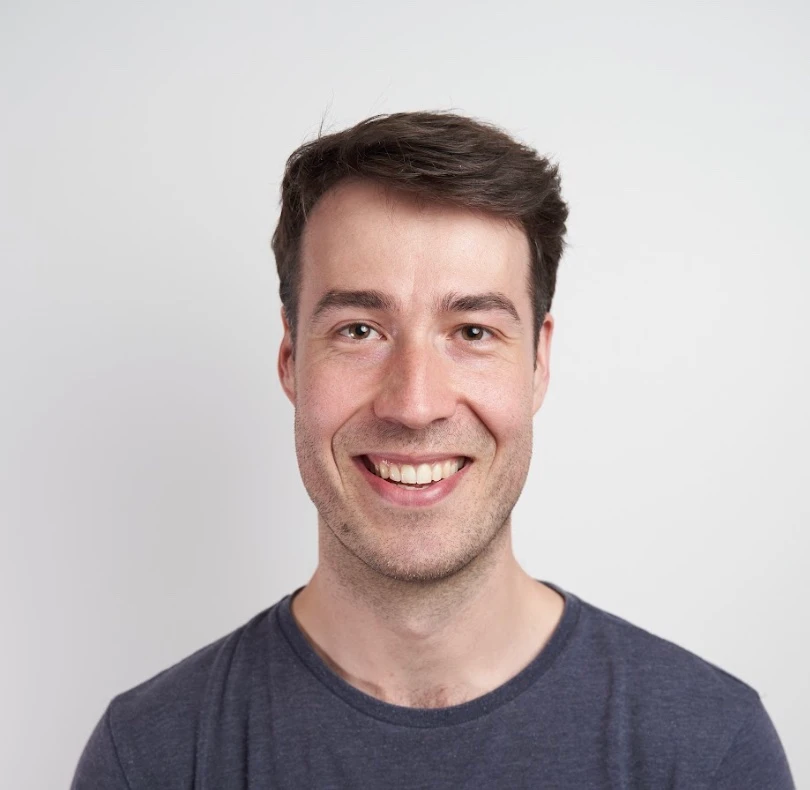
In the fall of 2023, Véronique Ducharme received the Fourwaves Excellence Scholarship in Environmental Sciences, awarded through the Université de Sherbrooke’s graduate excellence scholarship program. We told her story at the time: two years in occupational therapy, then chemical engineering and a master’s project at the Biomass Technology Laboratory (LTB) on converting combustion gases.
Two years later, her thesis is submitted and she works full time at Secant Fuel, a young Quebec company that makes low-carbon methanol from greenhouse gases. The company grew in part out of the project she worked on at the LTB. We called her back on October 19 to hear the rest.
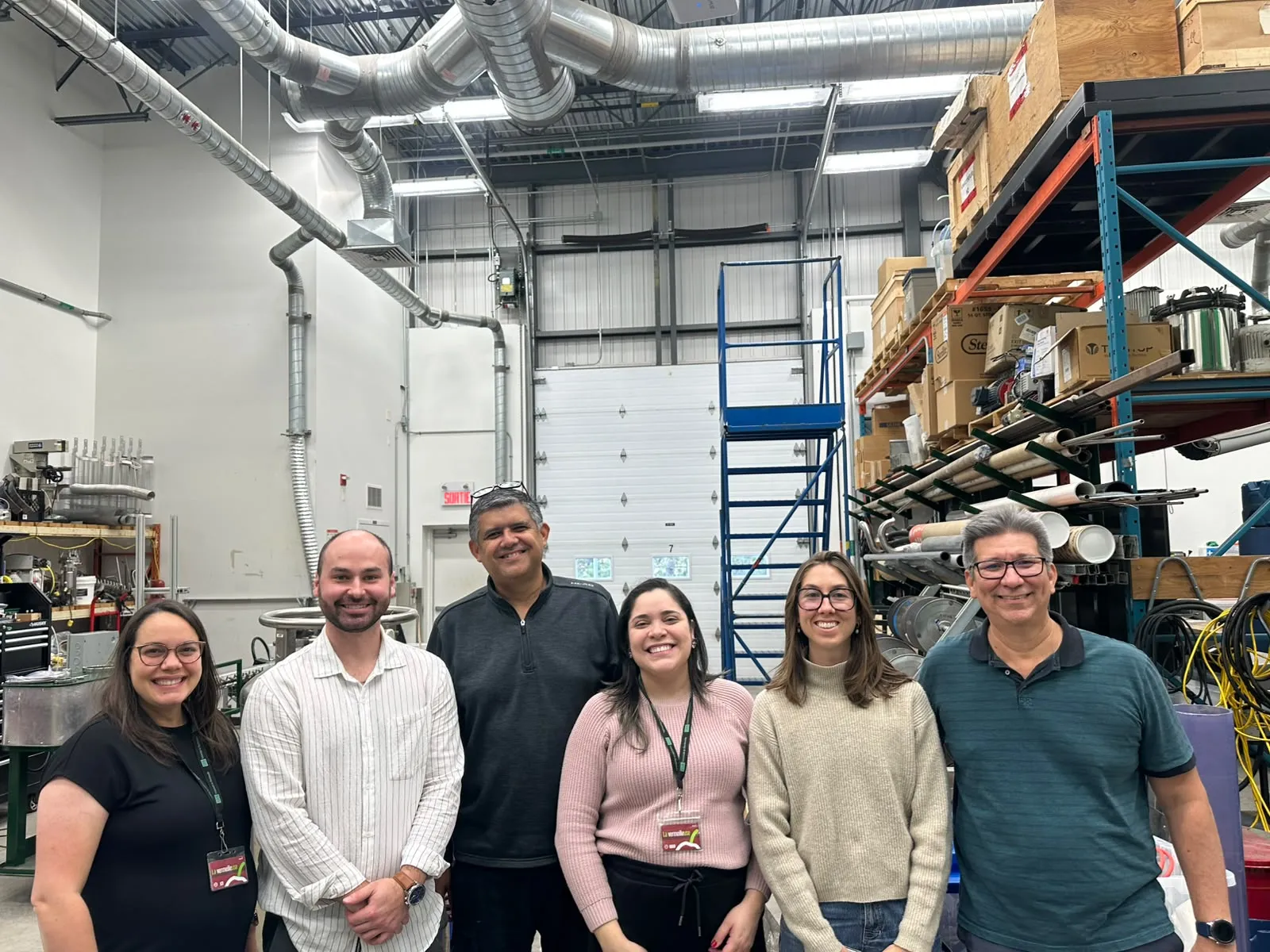
Véronique Ducharme with the Biomass Technology Laboratory team, including her supervisor Bruna Rego de Vasconcelos, in October 2026.
From occupational therapy to chemical engineering
Véronique entered the Université de Sherbrooke in occupational therapy. The choice went back a long way: wanting to help has always been part of who she is. After two years, doubt set in. “I wanted to help more globally, not just one person at a time,” she says.
Véronique then asked herself a question she now describes as optimistic and a little naive: which job would let her have the biggest impact on the climate?
The efforts we make at home are good, but industrial processes pollute enormously too. I told myself chemical engineering would be a good way to help.
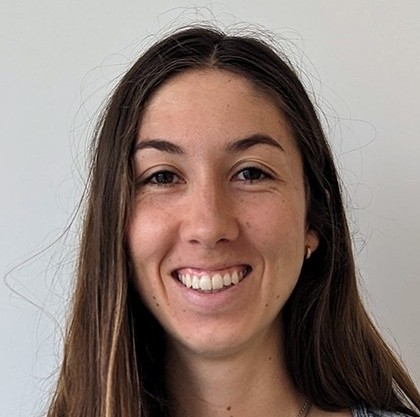
Applications engineering (CEP), Secant Fuel
In the third year of her bachelor’s in chemical engineering, a professor, Bruna Rego de Vasconcelos, opened her course by talking about her research. Véronique decided to approach her. “I dared to ask a professor who was working on a problem that interested me. That is how it started.”
At the end of her bachelor’s, she began her master’s at the LTB in the fall of 2023 under Professor Rego de Vasconcelos.
From chimney gases to syngas
Véronique’s project, explained as she would to a friend outside the field: a factory chimney mostly emits CO2 and nitrogen. In the LTB reactor, a catalyst helps turn that CO2 and water into syngas, a mix of hydrogen and carbon monoxide. “We take one oxygen away from the CO2 and one from the water.”
Syngas is the raw material refineries use to make fuels. The team is aiming for methanol.
Véronique’s contribution: understand how that reaction behaves in this system and turn it into a model. Give it the composition of the inlet gas and the operating conditions, and it predicts what comes out and how well. The model does two things:
- It shows which industries, each with its own gases, suit the process best.
- It is essential for moving from the lab to a plant: without it, there is no way to estimate the size of the reactor or the amount of material needed.
Her master’s took several months of planning and literature review, then a lot of lab testing, modelling and writing.
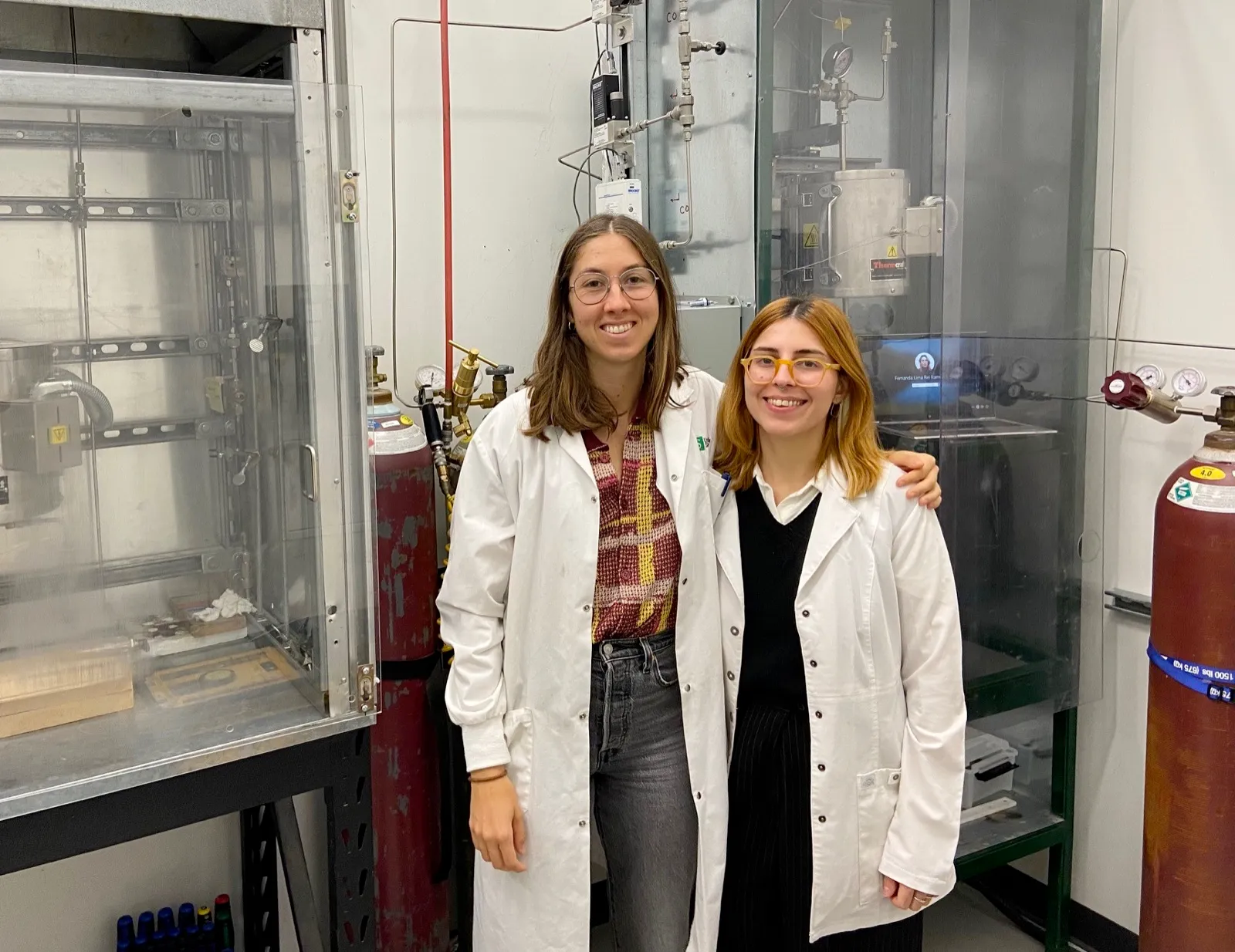
Véronique and a colleague in front of the reactor at the Université de Sherbrooke’s Biomass Technology Laboratory, October 2024.
An international conference in Japan
Because the technology is patent pending, Véronique could not share her work with the scientific community as much as she would have liked. She did present her methods at the International Conference on Engineering for Waste and Biomass Valorisation in Sendai, Japan, in front of researchers from around the world.
“I was still stressed right before. I do not remember much of the presentation, only the questions afterwards! I had practiced it so much that it came out on its own.” She even left with the Best Student Award.
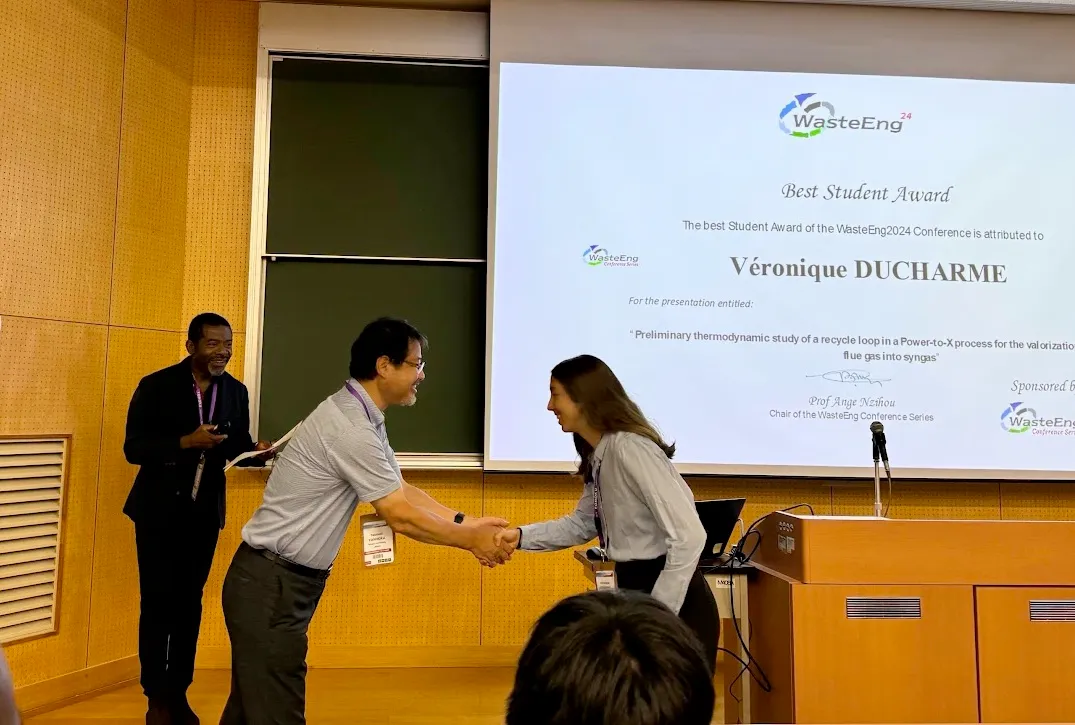
Véronique receives the Best Student Award at the 10th International Conference on Engineering for Waste and Biomass Valorisation (WasteEng24) in Sendai, Japan, in August 2024.
When a research project becomes a company
“I did not know it would become a company when I started,” she says. She knew she was working on a technology with a patent in progress, handled by TransferTech Sherbrooke, the university’s technology transfer office. Toward the end of her first year of the master’s, her supervisor told her about the plan to build a company around the technology, with her help. Secant Fuel has existed for about two years.
Since then, the technology has evolved: Secant Fuel’s process combines the methane and CO2 from biogas with steam to produce syngas. Bruna Rego de Vasconcelos is its technical director.
Véronique joined the team part time in May 2025, while writing her thesis, then full time in January 2026. The thesis is submitted and she is waiting for the jury’s corrections.
Secant Fuel: two problems, one molecule
Landfills and anaerobic digestion plants emit CO2 and methane, a greenhouse gas far more potent than CO2. Today, many of these sites simply flare the methane.
Secant Fuel proposes to capture these gases and turn them into methanol, going first through the syngas (CO + H2) described above. “It is a liquid product, simpler to store and transport, that has more value and can be sold elsewhere.” A waste becomes a resource for the site operator.
The second problem is downstream. The methanol made this way is a low-carbon fuel for sectors that are hard to electrify, starting with shipping, and an alternative for the chemical industry, which uses a lot of it made from fossil energy.
Where does the company stand? A site is reserved in Alberta for the first unit outside the lab, the one that must prove the process works outside a controlled environment, and the team is talking with many potential customers.
Véronique is a candidate to the engineering profession (CEP) in applications engineering there: the link between potential customers and engineering. Process simulations, techno-economic analyses, finding sites that suit the process.
We have titles, but we touch almost everything. In a consulting engineering firm, I would probably always do the same kind of project. Here I see everything it takes to move a company forward: the permits, the legal side, the funding applications.
Applications engineering (CEP), Secant Fuel
“It is a privilege to do what I do right now, to have a role in different decisions this early in my career,” she adds.
”It takes a village”
Asked about the support that mattered, Véronique lists it: the Fourwaves scholarship and other scholarships, National Research Council of Canada funding for the project, industrial partners including Sequoia and Hydro-Sherbrooke, the Université de Sherbrooke, the LTB, TransferTech, and her supervisor, “a daily support.”
“It takes a village, especially for projects that end up becoming companies. I do not think you can get anywhere one hundred percent on your own.”
And the Fourwaves scholarship, concretely?
Living the life of a master's student and a student athlete, staying mentally healthy, focusing on my projects without thinking about having to work part time. That is really the biggest thing.
Applications engineering (CEP), Secant Fuel
The scholarship also let her commit at a high level to several things at once. During her master’s she ran with the Vert & Or: 8 km cross-country in the fall, 600 to 1,000 metres indoors in winter.
And in 2024, at the Faculty of Engineering merit gala, she received the Léonard de Vinci merit medal (graduate level), the faculty’s highest distinction, which recognizes academic, extracurricular and professional activities as a whole.
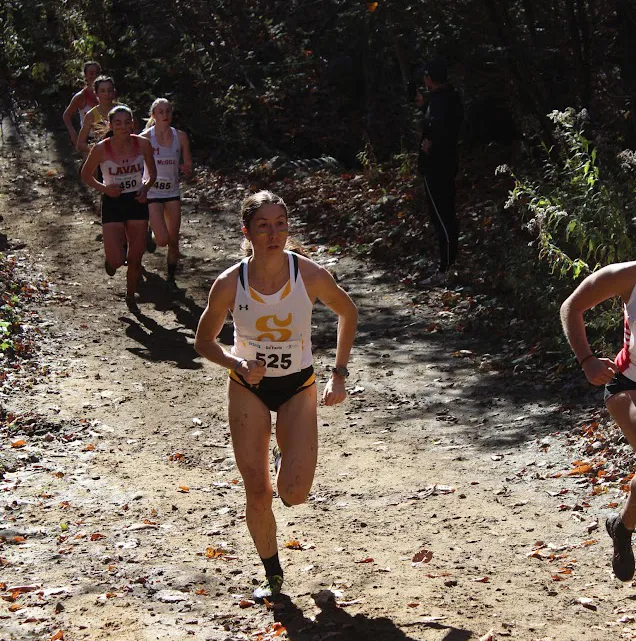
Véronique at the RSEQ cross-country championship with the Vert & Or, 2024.
Before receiving it, she did not know companies could fund a scholarship. “Not everyone can afford graduate studies without a scholarship.”
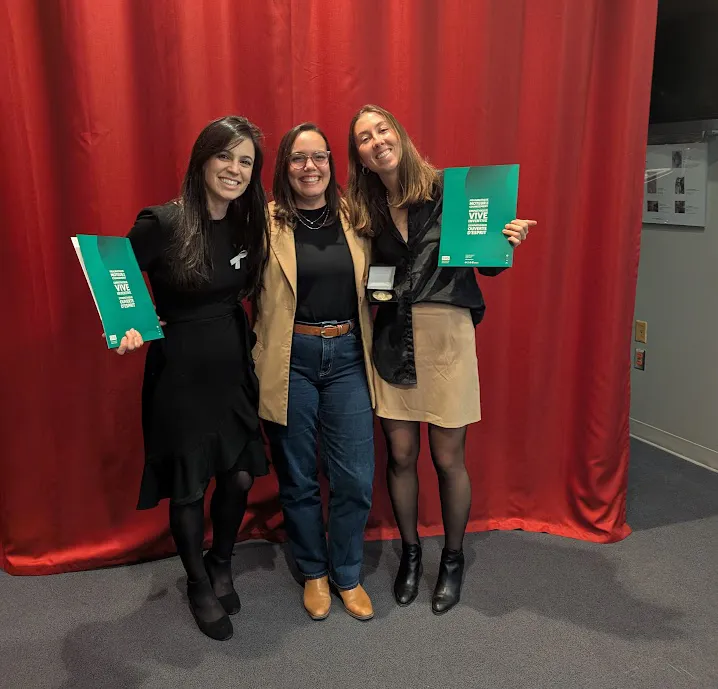
Véronique, Léonard de Vinci merit medal in hand, with her supervisor Bruna Rego de Vasconcelos and Ana Oliveira, a PhD student working on the life-cycle assessment of the process, at the 2024 Faculty of Engineering merit gala.
Her advice to graduate students
What would she say to a student wondering what their research will be good for? Véronique knew that feeling, with an added frustration: the patent kept her from talking freely about her project. Her answer comes down to one idea: share.
Share your knowledge. Talk about your project to as many people as possible, what you do and why you do it. When what we do is aligned with our values, I feel it leads to opportunities. One conversation can open up a field or a network.
Applications engineering (CEP), Secant Fuel
On the big question that followed her through her studies, the best way to have an impact, she has made her peace: “There is no best answer. I am happy to work every day on something that has the potential to make one and that is tied to my values. I could not have asked for better.”
Why Fourwaves funds research
Fourwaves is conference management software for academic conferences: abstract submissions, peer review, registration, event website, program and conference app in one platform, built for researchers at universities, scientific societies and research networks. Fourwaves runs academic conferences of any size, from international society meetings to departmental research days.
Our mission: supporting scientific events to break down the silos in research. Before Véronique’s scholarship, we gave $100 or $200 presentation prizes at conferences. She is the first person whose research project we funded over two years.
We will be following Secant Fuel’s first unit closely. Leading a research project that might interest us? Write to us.
To learn more: Secant Fuel, the Biomass Technology Laboratory and the Université de Sherbrooke Faculty of Engineering.